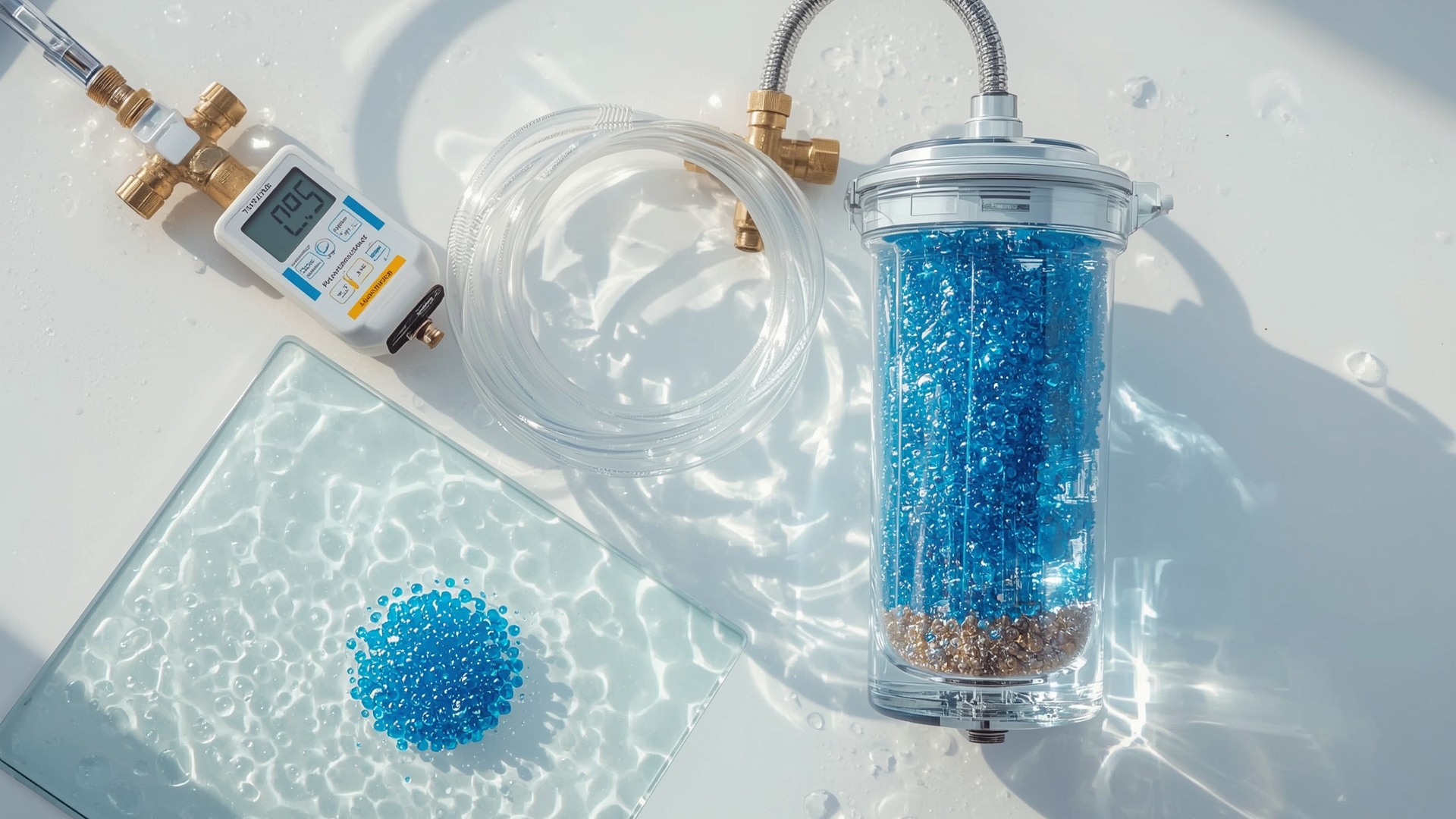
DI resin (deionization resin) is what turns hard tap water into spot-free, pure water for window cleaning. But it doesn’t last forever. The big variable that determines how fast it burns through is your water hardness. A cleaner in soft-water areas can get months of use from a single vessel. A cleaner working with very hard water might burn through the same vessel in a single day.
This guide covers how long DI resin realistically lasts at each hardness level, how to read the signs of exhaustion, what color-change resin tells you, and whether rechargeable or disposable vessels make more financial sense for your situation.
Key Takeaways
- Water hardness is the primary factor that determines DI resin lifespan. Harder water exhausts resin faster than any other variable.
- A TDS reading of 0-10 ppm at the outlet is the target for spot-free window cleaning. Once output climbs above 10 ppm, resin needs replacing or recharging.
- Color-change resin turns from blue/gold to brown/tan when exhausted, giving you a visual cue without needing a TDS meter.
- Rechargeable vessels cost less per liter over time, but disposable cartridges are lower entry cost and require no chemicals.
- Adding an RO membrane pre-filter before your DI vessel can extend resin life by 80-90% in hard water areas.
- Flow rate matters — pushing water through faster reduces contact time and increases TDS output, shortening effective resin life.
What Determines How Long DI Resin Lasts?
Quick Answer: DI resin lifespan is controlled by your incoming water’s TDS (total dissolved solids) level, the volume of water processed, and flow rate. Higher TDS means faster exhaustion. A vessel rated for 500 liters at 200 ppm TDS may only last 100 liters at 800 ppm TDS.
DI resin works by swapping dissolved mineral ions in tap water for hydrogen and hydroxyl ions. The resin has a finite number of exchange sites. Every liter of water you push through uses up some of those sites.
Think of the resin like a sponge. It absorbs mineral ions until it’s full. Once full, it can’t absorb any more, and your output water starts carrying those minerals again. The harder your water, the faster the sponge fills up.
What Is TDS and Why Does It Matter?
TDS stands for total dissolved solids. It measures the combined concentration of all dissolved minerals and salts in water, expressed in parts per million (ppm) or milligrams per liter (mg/L). For window cleaning, you want output TDS as close to 0 ppm as possible. Values above 10 ppm risk leaving spots on glass after drying.
Key Variables That Affect Resin Life
- Incoming TDS level: The biggest factor. Every extra ppm of incoming TDS reduces how many liters the resin can process.
- Flow rate: Faster flow means less contact time between water and resin beads. Less contact time means less efficient ion exchange and higher output TDS.
- Temperature: Colder water moves more slowly through resin, slightly improving efficiency. Very cold water (below 4°C / 39°F) can make resin less effective.
- Resin quality: Nuclear-grade or premium mixed-bed resin has more exchange capacity than budget alternatives.
- Pre-filtration: A sediment pre-filter or RO membrane upstream protects resin from suspended particles and dramatically reduces incoming TDS.
How Long Does DI Resin Last at Different Water Hardness Levels?
Quick Answer: In soft water (under 100 ppm TDS), a standard 10-liter DI vessel can process 1,500 to 2,500 liters before exhaustion. In very hard water (above 500 ppm TDS), that same vessel may process only 150 to 300 liters. Actual results vary with flow rate and resin grade.
The table below gives realistic processing estimates for a standard 10-liter mixed-bed DI vessel. These figures assume a flow rate of 1 to 2 liters per minute and nuclear-grade resin. Lower-grade resin will yield roughly 15-25% fewer liters.
| Water Hardness Category | Incoming TDS (ppm) | Approx. Liters Per 10L Vessel | Approx. Gallons Per 10L Vessel | Typical Duration (Professional Use) |
|---|---|---|---|---|
| Soft | 0–100 ppm | 1,500–2,500 L | 396–660 gal | 3–6 months |
| Moderately Hard | 101–200 ppm | 700–1,200 L | 185–317 gal | 4–10 weeks |
| Hard | 201–400 ppm | 300–600 L | 79–158 gal | 1–4 weeks |
| Very Hard | 401–600 ppm | 150–280 L | 40–74 gal | 3–10 days |
| Extremely Hard | 601–900+ ppm | 80–140 L | 21–37 gal | 1–3 days |
These ranges assume no pre-filtration. If you’re running an RO membrane before your DI vessel, your incoming TDS could drop from 400 ppm to 20–40 ppm. That single change can move you from the “hard” row to the “soft” row in the table above.
How Does Water Hardness Vary by Region?
In the UK, hard water zones include London, the South East, and the East of England, with TDS levels often ranging from 250 to 450 ppm. Scotland and the North West typically run softer at 50 to 150 ppm. In the US, the South West (Arizona, Nevada, California) regularly sees TDS above 400 ppm. The Pacific Northwest and New England tend to be softer at 50 to 200 ppm.
Knowing your specific incoming TDS is essential. Use a TDS meter to test your mains water before buying any resin setup. It takes 30 seconds and tells you exactly which row of the table above applies to you.
What Are the Signs That DI Resin Is Exhausted?
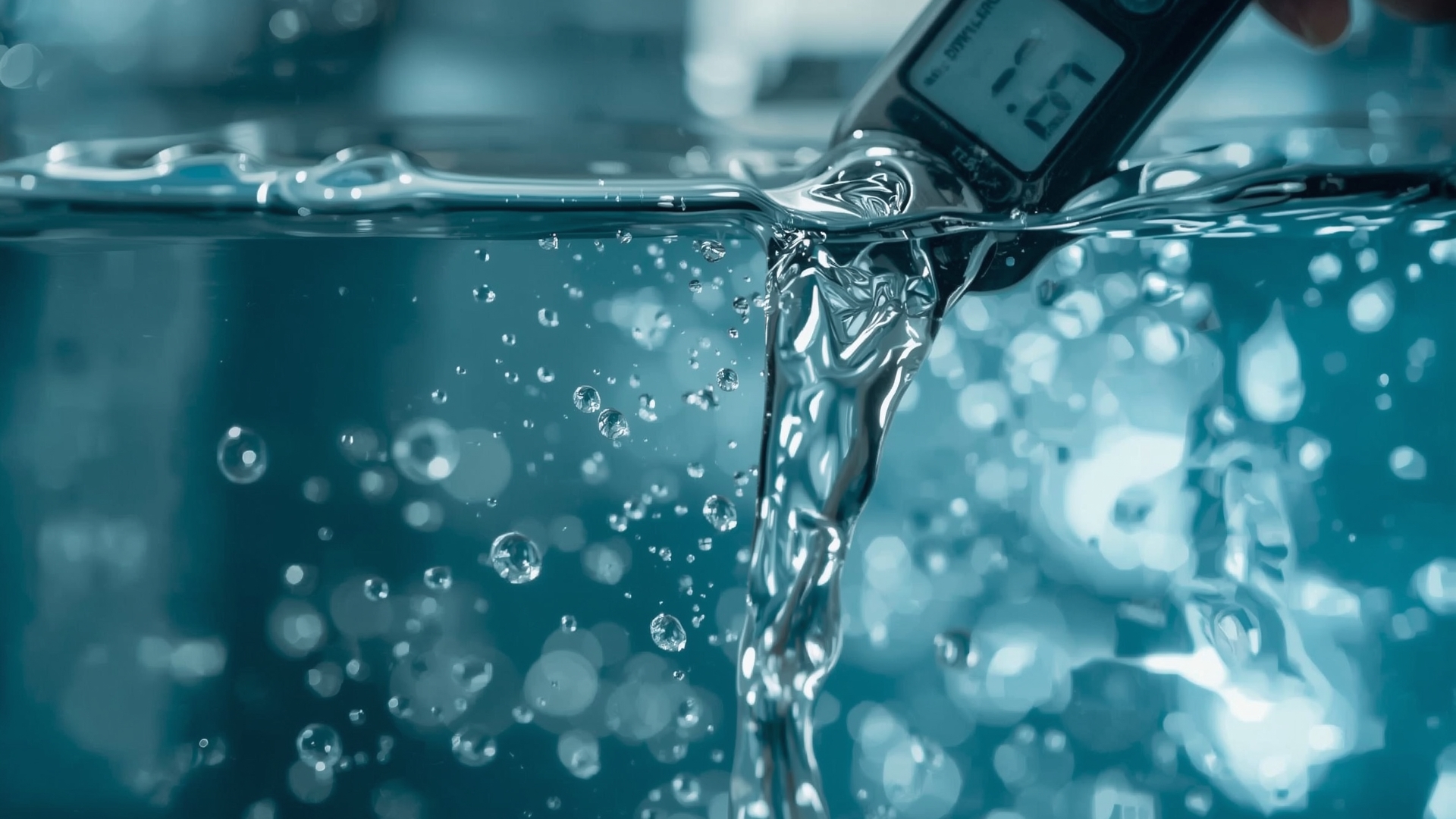
Quick Answer: The clearest sign of exhausted DI resin is a rising TDS reading at the vessel outlet. Once output climbs above 10 ppm, the resin needs replacing or regenerating. Spotting on glass after windows dry is the visible field sign.
Catching resin exhaustion early saves time and protects your reputation. Here are the signs to watch for.
TDS Meter Reading Climbing Above 10 ppm
This is the definitive test. Hold a TDS meter probe in the water coming out of your DI vessel. If the reading is 0–5 ppm, you’re good. If it creeps toward 10–15 ppm, you’re approaching exhaustion. If it hits 20 ppm or above, stop using the resin for window cleaning immediately.
Monitor TDS at the start of every job. Resin can go from fine to exhausted mid-day if you’re working in hard water areas. Checking only once in the morning leaves you exposed for the rest of the day.
Water Spots Appearing on Glass After Drying
If you’re finishing windows and they’re drying with faint circular spots or hazy patches, your output water carries dissolved minerals. This is the visible symptom of what your TDS meter should have caught earlier.
Spots after using “purified” water are a reliable indicator that the resin has failed. Check your TDS meter immediately when this happens.
Output Flow Rate Dropping Noticeably
As resin beads exhaust and break down over time, they can compact or fragment. This restricts water flow through the vessel. A significant drop in flow rate — not explained by a blocked pre-filter — can indicate the resin is degrading mechanically as well as chemically.
Resin EAV Summary: Exhaustion Indicators
| Indicator | Normal Range | Warning Range | Replace / Recharge Threshold |
|---|---|---|---|
| Output TDS | 0–5 ppm | 6–10 ppm | Above 10 ppm |
| Visible Spotting on Glass | None | Faint marks on some panes | Consistent spotting on all panes |
| Flow Rate (10L vessel) | 1–2 L/min | 0.7–1 L/min | Below 0.5 L/min (mechanical degradation) |
| Color (color-change resin) | Blue or gold | Mixed blue-brown | Fully brown or tan |
How Does Color-Change DI Resin Work?
Quick Answer: Color-change DI resin contains a pH indicator dye. When the resin is active, it stays blue or gold. As it exhausts and the pH of the exchange sites shifts, the dye changes to brown or tan. The color change starts from the bottom of the vessel and moves upward.
Color-change resin is a popular choice for window cleaners because it gives a visual status check at a glance. Clear-bodied vessels (sometimes called sight glass vessels) let you watch the color progression without any testing equipment.
How to Read Color-Change Resin Progress
Fresh resin fills the vessel in its active color — typically blue for cation resin, gold or amber for anion resin, or a mix of both for mixed-bed resin. As water enters from the top and flows downward, the mineral ions are absorbed from the top of the bed first.
You’ll notice the color change starting at the bottom of the vessel first — this seems counterintuitive, but it’s because the resin at the inlet (top) stays fresh longer while the exhausted zone travels upward. When the brown or tan color reaches about 75% of the vessel height, it’s time to act. By the time it reaches the top, you’ve likely already seen rising TDS.
Is Color-Change Resin as Accurate as a TDS Meter?
Color-change resin is a reliable early-warning indicator, but it’s not a replacement for a TDS meter. The dye can fade over time in some lower-cost resins. Temperature extremes can also affect the color response. Use color change as your visual signal and a TDS meter as your confirmation tool.
How Does an RO Membrane Extend DI Resin Life?
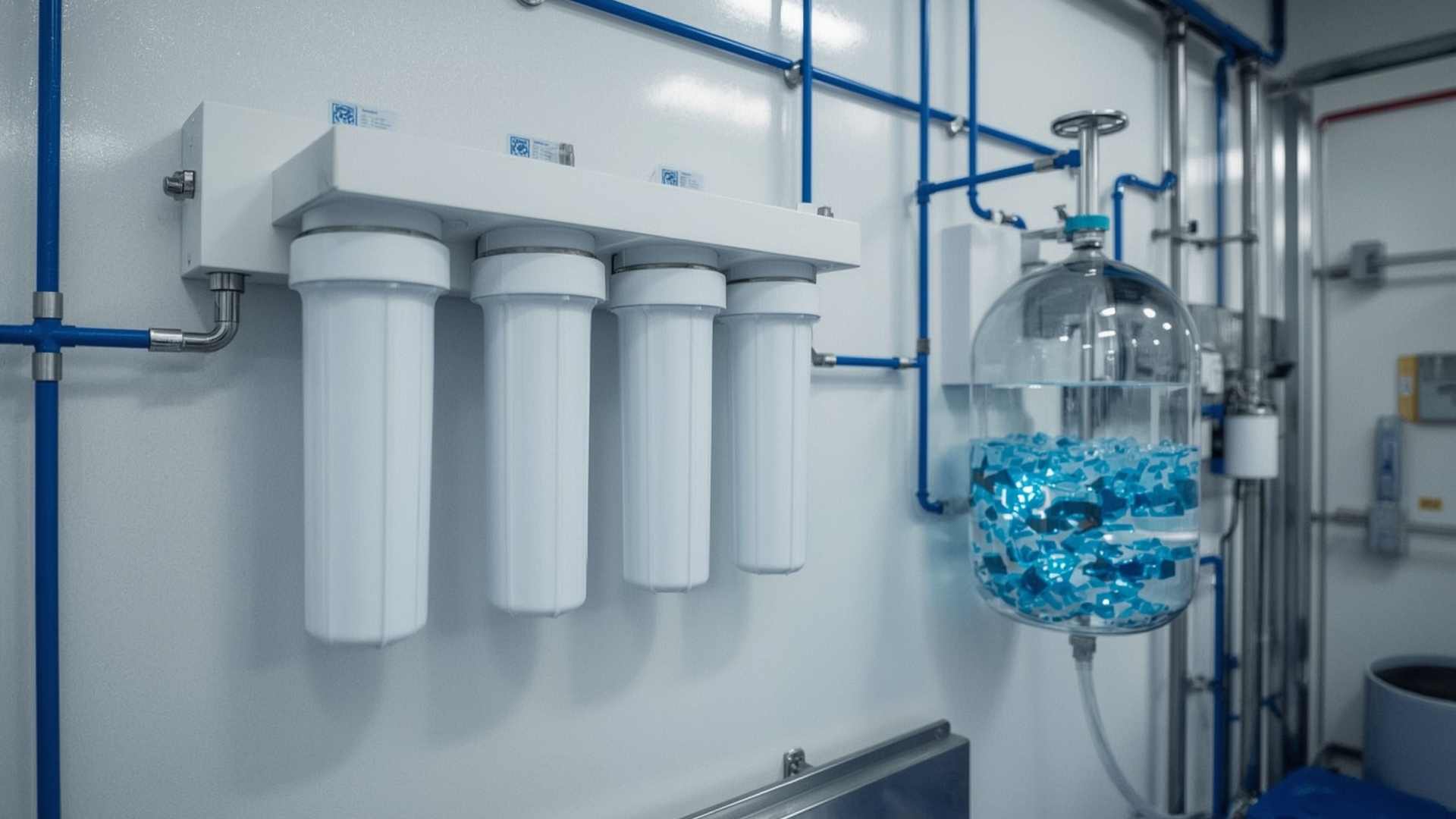
Quick Answer: A reverse osmosis (RO) membrane placed before the DI vessel removes 90–99% of dissolved minerals, dropping incoming TDS from hundreds of ppm down to 10–50 ppm. This can make DI resin last 5 to 20 times longer in hard water areas.
An RO membrane uses pressure to push water through a semi-permeable membrane, blocking most dissolved minerals and sending them to drain as reject water. The filtered water — called permeate — typically comes out at 10–50 ppm TDS even when incoming water is 400–600 ppm.
The DI resin then only needs to polish out that remaining 10–50 ppm. This is far less work than handling 400–600 ppm from scratch. The result is dramatically longer resin life.
RO + DI System vs. DI Only: Cost Impact by Water Hardness
| Setup | Incoming TDS | Post-RO TDS | Post-DI TDS | Resin Life (10L vessel) | Annual Resin Cost (Est.) |
|---|---|---|---|---|---|
| DI Only — Soft Water | 80 ppm | N/A | 0–3 ppm | 2,000+ L | £30–£60 / $40–$80 |
| DI Only — Hard Water | 350 ppm | N/A | 0–3 ppm | 400 L | £200–£400 / $260–$520 |
| DI Only — Very Hard Water | 550 ppm | N/A | 0–3 ppm | 180 L | £500–£900 / $650–$1,200 |
| RO + DI — Hard Water | 350 ppm | 25 ppm | 0–3 ppm | 3,500+ L | £25–£50 / $35–$65 |
| RO + DI — Very Hard Water | 550 ppm | 30 ppm | 0–3 ppm | 3,000+ L | £30–£60 / $40–$80 |
The table makes the math clear. In hard or very hard water areas, a DI-only setup can cost ten times more per year in resin than an RO + DI system. The RO unit adds upfront equipment cost (typically £200–£600 / $250–$800), but it pays back quickly in reduced resin spending.
Rechargeable vs. Disposable DI Resin Vessels: Which Costs Less?
Quick Answer: Rechargeable vessels cost more upfront (£30–£120 for the housing) but cost far less per liter over time because you buy bulk resin to refill them. Disposable cartridges are easier to manage but cost 3 to 6 times more per liter of processed water when bought individually.
Disposable DI Cartridges
Disposable cartridges come pre-filled and sealed. You connect them, use them until exhausted, and throw them away. They’re simple, clean, and require no chemicals or handling of loose resin. Popular sizes run from small inline cartridges (1–2 liters of resin) up to single-use vessels holding 5–8 liters.
The convenience carries a cost premium. Pre-filled cartridges typically cost £15–£40 / $20–$55 per liter of resin capacity. Over a year of hard-water cleaning, the replacement cost adds up fast.
Rechargeable (Refillable) Resin Vessels
Rechargeable vessels are hollow housings — typically made from polycarbonate or PVC — that you fill with loose mixed-bed resin. When the resin exhausts, you empty it and refill with fresh bulk resin. The housing is reused indefinitely.
Bulk mixed-bed resin typically costs £5–£12 / $7–$16 per liter when bought in 5–25 liter bags. That’s 3 to 6 times cheaper per liter than pre-filled disposable cartridges. The more volume you process, the bigger the cost advantage grows.
DI Vessel Cost Comparison: Rechargeable vs. Disposable
| Vessel Type | Housing Cost | Resin Cost Per Liter | Cost Per 10L Fill | Best For | Typical Resin Type |
|---|---|---|---|---|---|
| Disposable Inline Cartridge | £0 (included) | £18–£40 / $23–$55 | £18–£40 / $23–$55 | Occasional use, low volume | Mixed-bed, sealed |
| Disposable Single-Use Vessel | £0 (included) | £15–£25 / $20–$33 | £75–£125 / $100–$165 | Hobbyist, soft water areas | Mixed-bed, sealed |
| Rechargeable Vessel (small, 5L) | £30–£55 / $40–$72 | £5–£10 / $7–$13 | £25–£50 / $33–$65 | Part-time cleaners, soft water | Bulk mixed-bed |
| Rechargeable Vessel (large, 10–20L) | £60–£120 / $80–$158 | £5–£10 / $7–$13 | £50–£100 / $65–$132 | Professional, hard water | Bulk mixed-bed or nuclear-grade |
| Twin-Vessel Rechargeable System | £100–£200 / $132–$264 | £5–£10 / $7–$13 | £50–£100 / $65–$132 | High-volume professional use | Separate cation + anion resin |
Which Option Should You Choose?
If you clean windows occasionally — say, once or twice a month for your own home — a small disposable cartridge makes sense. The low upfront cost and zero handling of loose resin keep things simple.
If you clean professionally or in a hard water area, rechargeable vessels will likely save you hundreds of pounds or dollars per year. The break-even point against disposables is typically reached within 3 to 6 months of regular use.
How Can You Maximize DI Resin Lifespan?
Quick Answer: The most effective way to extend DI resin life is to install pre-filtration — specifically a sediment filter and RO membrane — before the DI vessel. This reduces incoming TDS by 90% or more. Controlling flow rate and storing resin correctly also add meaningful extra life.
Pre-Filtration Stack: What to Use Before Your DI Vessel
A proper pre-filtration sequence dramatically changes how hard your DI resin has to work. Here’s the standard setup professionals use:
- Sediment pre-filter (5 micron): Removes suspended particles, sand, and grit that would physically damage resin beads and clog the vessel.
- Carbon block filter: Removes chlorine and chloramines. These chemicals degrade resin beads over time, reducing their exchange capacity. This is especially important with municipally treated tap water.
- RO membrane: Removes 90–99% of dissolved minerals, dropping TDS from hundreds of ppm to single digits. This is the biggest single step for extending DI resin life in hard water areas.
- DI vessel: Final polishing stage. With the upstream work done by the RO membrane, the DI resin only handles trace remaining TDS.
Optimal Flow Rate for DI Resin Efficiency
DI resin needs contact time with water to transfer ions effectively. Pushing water through too fast is a common mistake. At 1 liter per minute through a standard 10-liter vessel, contact time is adequate. At 3–4 liters per minute, output TDS rises noticeably even with fresh resin — because water passes through too quickly for complete ion exchange.
Aim for 1 to 2 liters per minute through your DI vessel. If you need higher flow for a water-fed pole system, use a larger or twin vessel setup rather than increasing speed through a single small vessel.
Storage Best Practices to Prevent Resin Degradation
DI resin should stay moist. Letting it dry out causes the resin beads to shrink and crack. Cracked beads have less surface area for ion exchange and break into fine particles that can pass through mesh screens into your water supply. If you’re not using your system for more than a few days, keep the vessel filled with water or rinse and store in a sealed bag. Avoid freezing — ice expansion destroys resin bead structure.
What Is the True Cost Per Liter of Pure Water with DI Resin?
Quick Answer: With DI-only and soft water, pure water can cost as little as £0.002 to £0.01 per liter. In hard water with DI only, that rises to £0.05–£0.15 per liter. An RO + DI setup in hard water reduces cost back down to £0.01–£0.03 per liter, factoring in membrane and filter replacements.
Breaking cost down per liter helps you make smarter decisions about equipment investment. The numbers below are conservative estimates based on standard resin pricing.
| Setup | Water Hardness | Resin Cost Per Liter (Est.) | Total System Cost Per Liter (Inc. Pre-Filters) |
|---|---|---|---|
| DI Only — Rechargeable | Soft (80 ppm) | £0.003–£0.006 | £0.005–£0.01 |
| DI Only — Rechargeable | Hard (350 ppm) | £0.02–£0.04 | £0.025–£0.05 |
| DI Only — Disposable | Hard (350 ppm) | £0.08–£0.15 | £0.09–£0.16 |
| RO + DI — Rechargeable | Very Hard (550 ppm) | £0.002–£0.004 | £0.012–£0.025 |
Frequently Asked Questions
Can DI resin be regenerated at home instead of replaced?
Mixed-bed DI resin can technically be regenerated using strong acid and caustic soda solutions, but the process is complex, requires chemical handling safety equipment, and is rarely practical for window cleaners. Separate-bed systems (cation and anion resin in different vessels) are easier to regenerate. Most professionals in the window cleaning industry find that buying fresh bulk resin is simpler and safer than home regeneration.
Does the brand of DI resin affect how long it lasts?
Yes. Nuclear-grade mixed-bed resin has higher exchange capacity than standard water-softener-grade resin. Premium brands like Purolite MB400 and Dianion MB-1 offer more liters per kilogram than budget alternatives. For professional use, higher-grade resin typically costs 20–40% more but delivers 30–60% more processed volume.
How do I know my incoming water hardness before buying a setup?
A TDS meter is the fastest way. They cost £8–£25 / $10–$35 and give you a reading in seconds from your tap. You can also check your local water supplier’s annual water quality report, which lists hardness in mg/L or ppm. In the UK, Anglian Water and Thames Water publish regional hardness maps online.
What happens if I keep using exhausted DI resin on windows?
Exhausted resin produces water above 10 ppm TDS. When this water dries on glass, the dissolved minerals remain behind as visible water spots. On glass with existing mineral contamination or on frames and sills, repeated use of high-TDS water can accelerate mineral bonding and make subsequent cleaning harder. It won’t damage glass chemically the same way acid etching does, but it wastes your time and harms the finish quality.
Is mixed-bed resin the same as two-bed (separate cation and anion) resin?
No. Mixed-bed resin combines cation and anion resin beads in one vessel. Two-bed systems use separate vessels for cation resin (which removes positively charged ions like calcium and magnesium) and anion resin (which removes negatively charged ions like chloride and sulfate). Mixed-bed typically produces lower TDS output. Two-bed systems are easier to regenerate individually but require more equipment.
Can temperature affect how my DI resin performs during winter cleaning?
Yes. Water below 5°C (41°F) slows the ion exchange reaction in DI resin. This means you may see slightly higher output TDS in cold winter conditions even with fresh resin. Warming your water supply slightly before it enters the vessel, or reducing flow rate in cold weather, helps maintain output quality. Avoid letting vessels freeze, as ice expansion physically destroys resin beads.