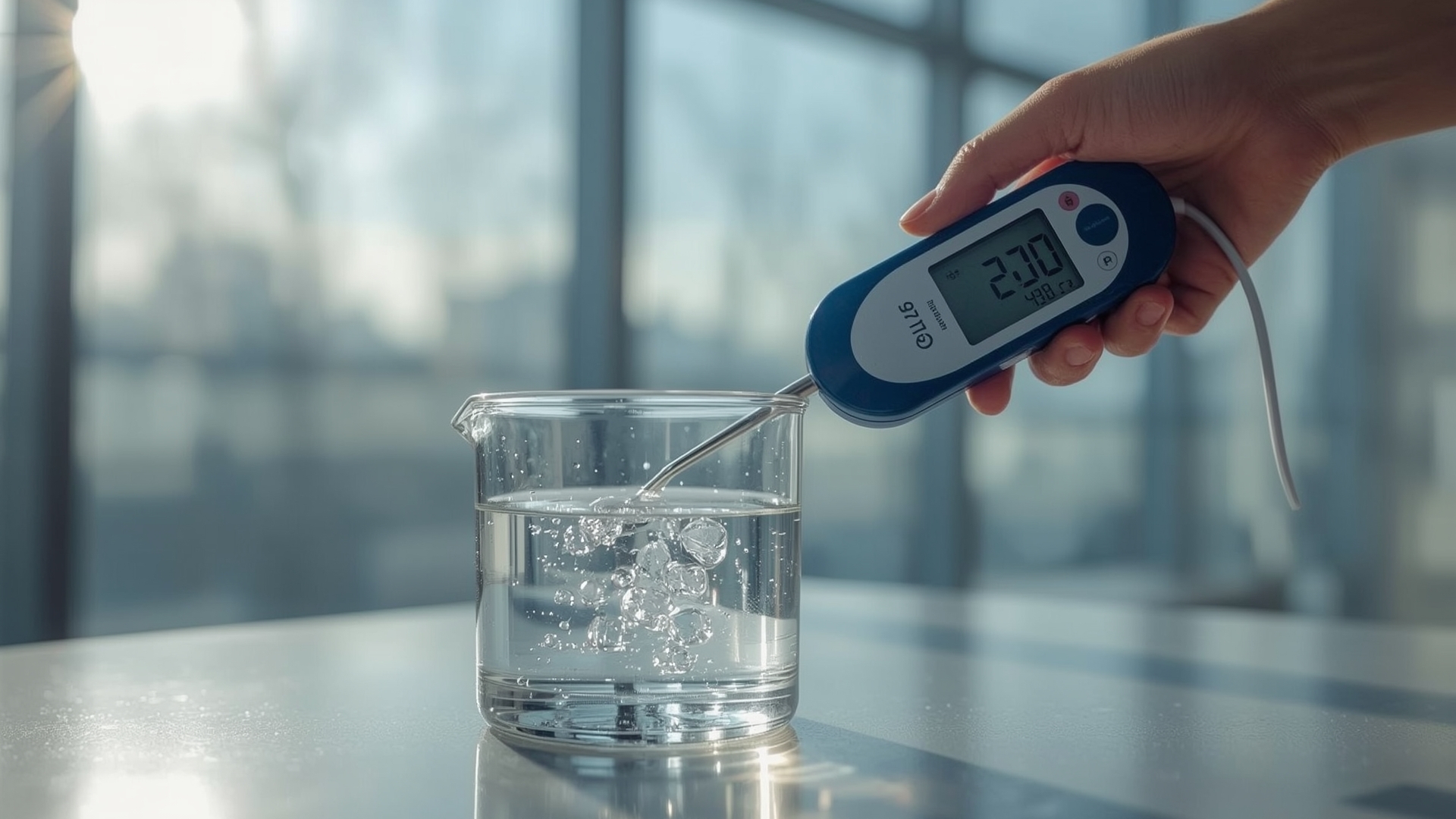
A TDS meter is a small handheld device that tells you how many dissolved solids are in your water. For window cleaning, those dissolved solids are the enemy. When water with minerals evaporates off glass, it leaves behind white spots and streaks. A TDS meter helps you know exactly when your water is pure enough to clean windows without leaving a trace.
Most window cleaners use a water-fed pole system with a deionized (DI) water filter. The TDS meter tells you whether that filter is still doing its job. Getting this number right is the difference between spotless glass and a frustrating redo.
Key Takeaways
- Safe TDS level for window cleaning is 0 ppm. Most professionals accept up to 10 ppm as a working maximum before results suffer.
- TDS stands for Total Dissolved Solids. It measures minerals, salts, and other particles dissolved in water, reported in parts per million (ppm).
- Tap water typically reads 150 to 400 ppm. That level will leave heavy spots and streaks on glass every time.
- DI resin is what brings TDS to 0. When the TDS reading climbs above 10 ppm at the filter outlet, the resin is exhausted and needs replacement.
- Test your water at three points: the tap, the filter inlet, and the filter outlet. Only the outlet number matters for cleaning results.
- Resin lifespan depends on your tap water hardness. Harder water exhausts DI resin faster, sometimes in as little as a few hundred gallons.
What Does a TDS Meter Actually Measure?
Quick Answer: A TDS meter measures the total concentration of dissolved solids in water, reported in parts per million (ppm). It detects minerals like calcium, magnesium, and sodium. It does not identify which specific minerals are present, only the total amount.
TDS stands for Total Dissolved Solids. In plain terms, it measures everything dissolved in water that isn’t water itself. That includes calcium, magnesium, sodium, bicarbonates, and other mineral ions that come from the ground or local water treatment.
The meter works by passing a small electrical current through the water sample. Dissolved minerals conduct electricity. The more minerals present, the more current passes through, and the higher the reading. Pure water with zero dissolved solids conducts almost no electricity, so it reads close to 0 ppm.
For window cleaning, TDS is a proxy for spotting risk. High TDS means high mineral content. High mineral content means visible spots when water dries on glass. The meter doesn’t tell you which minerals are present. It just tells you how much total dissolved material is there.
What Does PPM Mean on a TDS Meter?
PPM means parts per million. One ppm means one milligram of dissolved solids per liter of water. A reading of 200 ppm means there are 200 milligrams of dissolved material in every liter. That’s a small amount by weight, but it’s enough to leave visible spots on a clean window.
What TDS Meter Readings Actually Tell You
| TDS Reading (ppm) | Water Quality | Window Cleaning Result | Action Required |
|---|---|---|---|
| 0 | Pure deionized water | Spot-free, streak-free | None — ideal |
| 1 to 10 | Near-pure water | Streak-free on most glass | Monitor closely |
| 11 to 30 | Marginal quality | Possible light spotting | Replace resin soon |
| 31 to 100 | Low-quality filtered water | Visible spots and streaks | Replace resin immediately |
| 101 to 300 | Typical tap water | Heavy spotting and haze | Filtration not working |
| 300+ | Hard water | Severe mineral deposits | Full system check needed |
What Is the Safe TDS Level for Window Cleaning?

Quick Answer: The safe TDS level for window cleaning is 0 ppm. Most professionals use a maximum of 10 ppm as the cutoff. Water above 10 ppm risks leaving spots on glass as it dries. For the cleanest results with no room for error, aim for 0 ppm every time.
Zero is the goal. When your TDS meter reads 0 at the filter outlet, your water is pure enough to clean any glass surface and dry without leaving a mark. This is the standard used by professional window cleaning companies worldwide.
In practice, many professionals use 10 ppm as their working upper limit. Water between 1 and 10 ppm will still clean most windows without visible spotting. The risk increases on hot days when water evaporates faster, or on glass that’s already been exposed to hard water mineral buildup.
Once your meter reads above 10 ppm at the filter outlet, your DI resin cartridge is close to exhausted. At 30 ppm and above, you’ll see spotting on glass. At 100 ppm and above, you’re essentially cleaning with tap water — which will make windows look worse, not better.
Why 0 PPM Matters More on Certain Jobs
The 10 ppm tolerance is a professional guideline, not a guarantee. Some situations call for stricter standards. Solar panels, for example, need extremely pure water because mineral residue blocks sunlight and reduces energy output. Commercial storefronts with dark glass show spots more clearly than white-framed residential windows.
If you’re working in high heat or direct sun, even water at 5 ppm can cause light spotting because evaporation happens so quickly. In those conditions, aim for 0 every time.
How Do You Use a TDS Meter for Window Cleaning?

Quick Answer: Remove the cap, dip the metal probes 1 to 2 inches into the water sample, wait 10 seconds for a stable reading, then read the display in ppm. Test water at the tap, at the filter inlet, and at the filter outlet to track your system’s performance.
Step-by-Step: Testing Your Water with a TDS Meter
- Remove the protective cap from the bottom of the meter where the metal probes are located.
- Turn the meter on by pressing the power button. Most meters have a single button that toggles power and hold mode.
- Dip the probes into your water sample. Submerge them 1 to 2 inches deep. Don’t let the meter body touch the water.
- Wait for the reading to stabilize. This usually takes 5 to 15 seconds. The number will stop changing when it’s stable.
- Read the display. The number shown is your TDS in ppm. Some meters display “EC” (electrical conductivity) — press the mode button to switch to ppm.
- Press the hold button if your meter has one. This locks the reading so you can pull the meter out of the water and read it easily.
- Rinse the probes with clean water after each test and replace the cap before storing.
Where to Test: Tap vs. Filter Outlet
Always test at two points minimum: the tap (before your filter system) and the filter outlet (after your DI resin). The tap reading tells you how hard your local water is. The outlet reading tells you whether your filter is working.
If your tap reads 300 ppm and your outlet reads 0 ppm, your system is working perfectly. If your outlet reads 25 ppm, your resin is wearing out. If both readings are the same, your resin is completely exhausted.
How Does a DI Filter Bring TDS to Zero?

Quick Answer: A DI filter contains deionization resin — tiny beads that attract and trap mineral ions from the water. As water passes through the resin bed, minerals stick to the beads and pure water flows out the other side. The resin works until all the bead sites are full.
DI stands for deionization. The resin inside a DI filter is made of millions of tiny polymer beads. These beads have two types: cation resin beads that attract positively charged minerals like calcium and magnesium, and anion resin beads that attract negatively charged ions like chloride and bicarbonate.
When water flows through the resin bed, minerals swap places with hydrogen and hydroxide ions on the beads. The minerals stay stuck to the resin. The hydrogen and hydroxide ions combine in the water to form pure H2O. This is why the output TDS drops to 0.
The process is called ion exchange. Every mineral ion removed uses up one exchange site on the resin bead. When all the sites are used up, the resin is exhausted and can no longer remove minerals. That’s when your TDS reading starts climbing.
Mixed-Bed vs. Single-Bed DI Resin
Mixed-bed resin contains both cation and anion beads blended together in one cartridge. This produces the most thorough removal and consistently hits 0 ppm. Most window cleaning systems use mixed-bed resin for this reason.
Single-bed systems use separate cation and anion tanks in sequence. These are common in larger commercial setups where the tanks can be regenerated separately. For most window cleaners, mixed-bed cartridges are simpler and effective.
What Factors Affect How Long DI Resin Lasts?
Quick Answer: DI resin lifespan depends on your starting water TDS, how many gallons you process, and whether you use a pre-filter. Harder water exhausts resin faster. A carbon block pre-filter removes chlorine first, protecting the resin and extending its life significantly.
DI Resin Performance by Water Hardness
| Tap Water TDS (ppm) | Water Hardness | Approx. Resin Capacity (per liter of resin) | Estimated Gallons per 1L Cartridge |
|---|---|---|---|
| 0 to 50 | Very soft | Very high | 500 to 800 gallons |
| 51 to 150 | Soft to moderate | High | 300 to 500 gallons |
| 151 to 300 | Moderately hard | Moderate | 150 to 300 gallons |
| 301 to 500 | Hard | Lower | 75 to 150 gallons |
| 500+ | Very hard | Low | 40 to 75 gallons |
Using a Pre-Filter to Extend Resin Life
A sediment pre-filter removes sand, rust, and particulates before water reaches your DI resin. A carbon block pre-filter goes further by removing chlorine and chloramines. Chlorine attacks DI resin and degrades it faster than mineral content alone.
Running tap water through a carbon block pre-filter before it hits your DI resin can double or triple resin lifespan in chlorinated municipal water supplies. This is one of the simplest ways to reduce your resin replacement costs.
When Should You Replace Your DI Resin Cartridge?
Quick Answer: Replace your DI resin cartridge when the TDS reading at the filter outlet consistently reads above 10 ppm. Don’t wait for spotting to appear on glass. The meter gives you advance warning. Testing before each job prevents wasted time and a ruined clean.
Signs Your DI Resin Is Exhausted
- TDS meter at the outlet reads 10 ppm or higher consistently. A brief spike can happen on startup — a sustained reading above 10 ppm means it’s time to replace.
- Spots appear on glass after rinsing. This is a visual confirmation the water is no longer pure, but it’s a lagging indicator — the meter would have caught it first.
- Color change in transparent resin cartridges. Many mixed-bed resins ship with color-indicating beads. Fresh resin is often blue/green. Exhausted resin turns orange/brown as the beads fill with minerals.
- The TDS reading at the outlet matches the inlet. If your outlet reads the same as your tap, the resin has zero capacity left and is passing water straight through.
How Often Should You Test TDS?
Test before every job, especially at the start of a new workday. A cartridge that read 2 ppm at the end of yesterday might read 8 ppm today if the resin has continued to slowly release trapped ions. Testing takes less than 30 seconds and prevents the frustration of re-cleaning an entire building.
If you’re mid-job and suspect the resin is fading, test at the outlet again. TDS can climb gradually, so a job that starts at 0 ppm might creep to 12 ppm by the time you’re halfway through a large building if the resin is near the end of its life.
How Do You Choose a TDS Meter for Window Cleaning?
Quick Answer: Choose a TDS meter with a 0 to 999 ppm range, ±2% accuracy, auto-temperature compensation, and a hold function. Pen-style meters in the $10 to $30 range work well for most window cleaners. Calibration matters more than brand name.
TDS Meter Specifications Compared
| Feature | Entry-Level Meter ($10 to $20) | Mid-Range Meter ($20 to $50) | Professional Meter ($50 to $150) |
|---|---|---|---|
| Accuracy | ±3 to 5% | ±2% | ±1 to 2% |
| Range | 0 to 999 ppm | 0 to 9,990 ppm | 0 to 9,990 ppm with EC mode |
| Temperature Compensation | Manual or none | Automatic (ATC) | Automatic (ATC) |
| Hold Function | Sometimes | Yes | Yes |
| Calibration | Factory only | User-adjustable | Multi-point calibration |
| Battery Life | 1,000 to 2,000 hours | 2,000 to 5,000 hours | 3,000 to 8,000 hours |
| Best For | Home window cleaners | Part-time professionals | Full-time commercial work |
Why Temperature Compensation Matters
Water temperature affects how well it conducts electricity. Cold water conducts less, which makes dissolved solids appear lower than they actually are. Hot water conducts more, making TDS appear higher.
A meter with automatic temperature compensation (ATC) corrects for this automatically. It measures the water temperature and adjusts the reading to a standard reference temperature of 25°C (77°F). This gives you accurate readings whether you’re testing cold tap water in winter or warm water on a summer job.
What Is the Difference Between TDS and Water Hardness?
Quick Answer: Water hardness measures only calcium and magnesium levels, reported in grains per gallon (GPG) or milligrams per liter (mg/L). TDS measures all dissolved solids combined. Hard water always has high TDS, but high TDS water isn’t always hard — it could contain sodium or other minerals instead.
Water hardness is a subset of TDS. When people talk about hard water, they specifically mean water with high calcium and magnesium content. These minerals are particularly problematic for windows because they bond to glass and form stubborn white deposits.
TDS includes calcium and magnesium, but also sodium, potassium, chloride, sulfate, and other dissolved materials. A water softener, for example, replaces calcium and magnesium with sodium. This lowers hardness but doesn’t lower TDS — it might even raise the TDS reading slightly.
For window cleaning, TDS is the more useful measurement because it captures all mineral spotting risk in one number. You don’t need to know which specific minerals are present. You just need to know the total is low enough that they won’t leave marks.
How Does Your Local Water Supply Affect TDS Readings?
Quick Answer: Local geology and water treatment determine your baseline tap water TDS. Regions with limestone or chalk bedrock commonly read 200 to 500 ppm. Coastal areas and regions with granite bedrock often read 50 to 150 ppm. Your water utility’s annual quality report shows your area’s specific average.
Tap Water TDS by Water Source Type
| Water Source Type | Typical TDS Range (ppm) | Primary Minerals | Impact on Resin Life |
|---|---|---|---|
| Mountain snowmelt / glacier | 10 to 50 | Low mineral content | Very long resin life |
| Surface reservoir (treated) | 50 to 200 | Chlorine, low minerals | Long life with pre-filter |
| Limestone / chalk geology | 200 to 500 | Calcium, magnesium bicarbonate | Moderate to short resin life |
| Well water (agricultural area) | 300 to 800 | Calcium, nitrates, iron | Short resin life |
| Coastal groundwater | 200 to 600 | Sodium, chloride | Moderate to short resin life |
How to Find Your Local Tap Water TDS
The fastest way is to test it yourself with your TDS meter. Run your tap for 30 seconds, fill a clean glass, and test it. The number you get is your baseline. This is the TDS your DI filter has to overcome with every gallon it processes.
You can also request your utility’s Consumer Confidence Report (CCR). This annual report lists your water’s mineral content and is available online or by calling your water provider. It gives you a reliable baseline for planning filter maintenance.
Can You Use RO Water Instead of DI Water for Window Cleaning?
Quick Answer: Reverse osmosis (RO) water alone is not pure enough for spot-free window cleaning. RO typically achieves 90 to 99% mineral removal, which still leaves 5 to 50 ppm depending on tap water quality. Combining RO with DI filtration achieves 0 ppm and extends DI resin life by reducing the load on the resin.
Reverse osmosis uses a semi-permeable membrane under pressure to filter out most dissolved solids. A good RO membrane rejects 95 to 99% of minerals. But it doesn’t reach zero. If your tap water reads 300 ppm, RO output might still read 15 to 30 ppm — not clean enough for professional results.
The RO plus DI combination is popular in professional setups. The RO membrane does the heavy lifting by removing most of the mineral content. The DI resin then polishes the remaining trace minerals to 0 ppm. Because the resin receives pre-filtered water from the RO stage, it lasts much longer before needing replacement. This setup makes economic sense when your tap water TDS is above 200 ppm.
RO vs. DI vs. RO+DI for Window Cleaning
| System Type | Typical Output TDS | Spot-Free Result | Resin/Membrane Cost | Best For |
|---|---|---|---|---|
| DI Only | 0 ppm | Yes | High (frequent replacement) | Soft water areas (under 150 ppm tap) |
| RO Only | 5 to 50 ppm | Marginal to no | Low (membrane lasts years) | Not suitable as standalone |
| RO + DI | 0 ppm | Yes | Moderate (resin lasts longer) | Hard water areas (above 200 ppm tap) |
Frequently Asked Questions
Can I clean windows with tap water if I use a squeegee?
Yes, but results depend on your water hardness. A squeegee removes most of the water before it can evaporate and leave spots. In soft water areas below 50 ppm, tap water with a squeegee can produce clean results. In hard water areas above 150 ppm, mineral residue remains even after squeegee work and leaves a haze on the glass surface.
What happens if I use water at 15 ppm to clean windows?
Light spotting is likely, especially on warm or sunny days when water evaporates quickly. At 15 ppm, the mineral load is low enough that results may look acceptable in cooler conditions. For any professional standard or commercial job, replace the resin before exceeding 10 ppm to avoid callbacks.
How do I store my TDS meter to keep it accurate?
Always replace the protective cap over the probes before storing. Keep the meter dry and away from direct sunlight. Rinse the probes with clean water after each use to prevent mineral buildup on the electrodes, which can cause false readings over time. Store in a case or pouch if possible to protect the display.
Does water temperature change the TDS reading?
Yes. Warmer water conducts electricity better, which can make TDS appear higher than it is. Cooler water conducts less, making TDS appear lower. A meter with automatic temperature compensation (ATC) adjusts for this difference automatically. Without ATC, test water at room temperature for the most consistent readings.
Is a TDS meter the same as a conductivity meter?
Not exactly. A conductivity meter measures electrical conductivity in microsiemens per centimeter (µS/cm). A TDS meter uses that conductivity reading and applies a conversion factor (typically 0.5 or 0.7) to estimate total dissolved solids in ppm. Many meters display both measurements and let you switch between them with a button press.
Can I regenerate DI resin at home instead of replacing it?
Technically, yes. DI resin can be regenerated using acid and caustic chemicals to flush out trapped minerals and recharge the ion exchange sites. In practice, home regeneration requires handling hydrochloric acid and sodium hydroxide, which are hazardous. Most window cleaners find it safer and more cost-effective to replace spent cartridges with fresh resin rather than attempt regeneration without proper equipment.