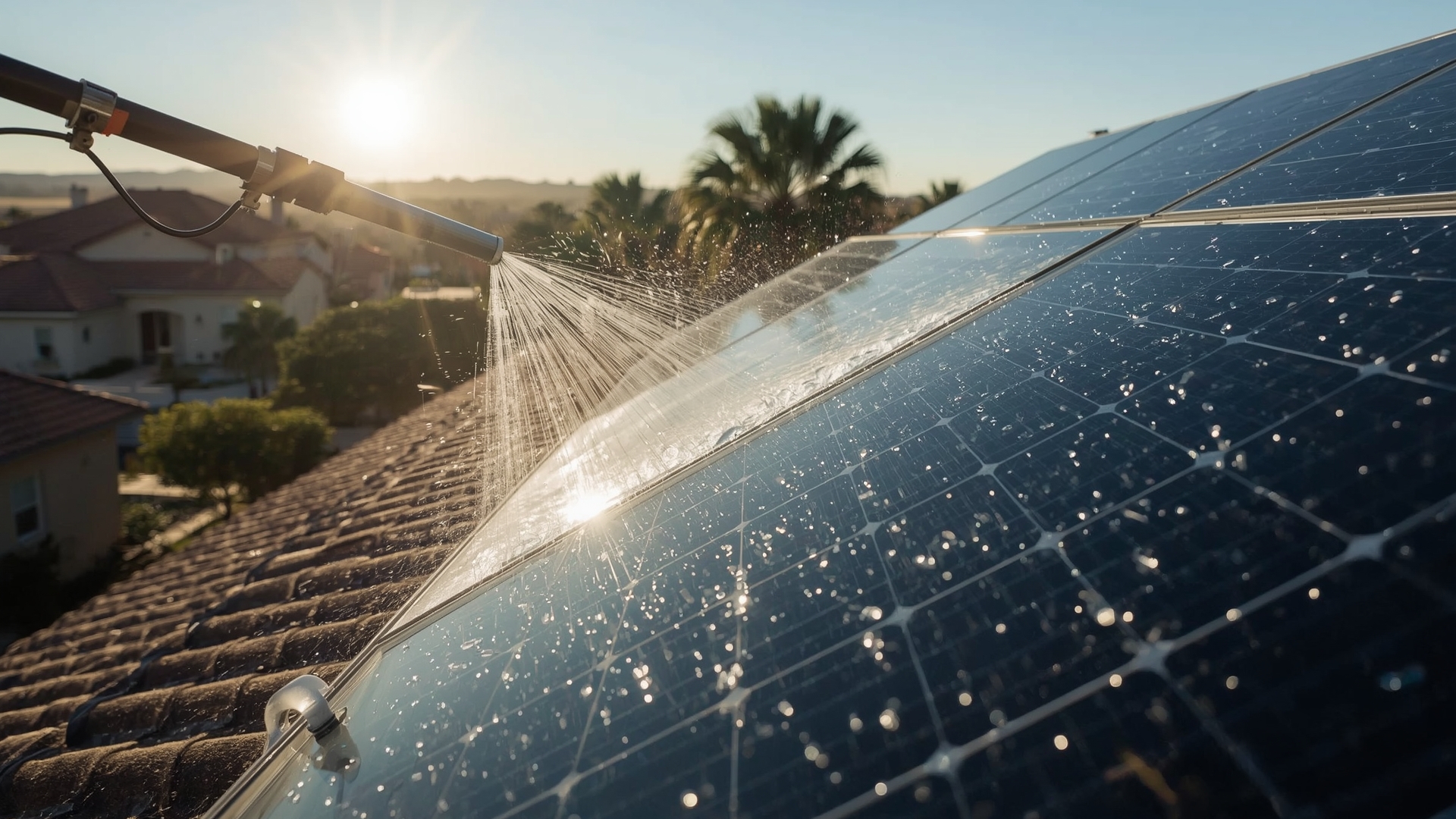
Solar panels lose output every time dust, pollen, bird droppings, and mineral deposits build up on the glass surface. A water fed pole (WFP) system solves this problem without ladders, without harsh chemicals, and without risking damage to the panel glass or frame. You use a telescoping pole with a brush head and a supply of purified water to gently agitate and rinse the surface clean.
This guide covers everything you need to know about using a WFP system for solar panel maintenance — from safe pressure levels and brush selection to cleaning frequency for residential and commercial arrays.
Key Takeaways
- Pure water is essential: Water with a TDS (total dissolved solids) below 10 ppm leaves no mineral spots or streaks after drying.
- Safe pressure range: Keep water pressure between 40 and 60 PSI at the brush head to avoid frame seal damage.
- Soft brush heads only: Use boar’s hair or soft nylon bristles rated for glass surfaces — never stiff bristles or abrasive pads.
- Residential frequency: Clean every 3 to 6 months in most climates, more often in dusty or high-pollen environments.
- Commercial arrays: Clean every 4 to 8 weeks depending on soiling rate and performance monitoring data.
- No cleaning agents needed: Pure water alone removes most soiling types when paired with proper brush agitation.
- Ground-level operation: A 30-foot carbon fiber or fiberglass pole reaches two-story rooftop panels from the ground.
What Is a Water Fed Pole System for Solar Panel Cleaning?

Quick Answer: A water fed pole system is a telescoping pole with a brush head that delivers purified water through internal channels to the brush face. It cleans solar panels from ground level using gentle scrubbing and a pure water rinse, leaving no residue.
The core components are straightforward. A water source (usually a deionized or reverse osmosis filtered tank) pumps purified water through a hose attached to the pole. The water travels up the inside of the pole and exits through jets or channels built into the brush head. As you scrub, the water loosens soiling and carries it off the panel surface during the rinse.
The key advantage over traditional cleaning methods is safety. You stay on the ground for most residential and low-commercial installations. There are no ladders, no squeegees dragged across the panel glass, and no detergent residues that can attract dust faster or void manufacturer warranties.
How Does Pure Water Make Solar Panel Cleaning Better?
Tap water contains dissolved minerals — calcium, magnesium, silica. When tap water dries on a glass surface, those minerals are left behind as white spots. On solar panels, those spots scatter and block incoming sunlight.
Purified water with a TDS reading below 10 ppm contains almost no dissolved solids. When it dries, it leaves nothing behind. The result is a clean panel surface with no mineral haze and no need for a second pass.
What Equipment Do You Need to Clean Solar Panels With a Water Fed Pole?
Quick Answer: You need a telescoping WFP pole (30 to 60 feet for most homes), a soft glass-safe brush head, a purified water source (DI or RO filtered to under 10 ppm TDS), a pump, and a supply hose. A TDS meter confirms water quality before you start.
Pole Material and Length
Carbon fiber poles are lighter and stiffer than fiberglass, which makes them easier to maneuver at full extension. For a two-story home with panels on a standard pitch roof, a 30-foot pole is usually enough. Larger commercial buildings may require 45 to 60-foot sections.
The tradeoff is cost. Carbon fiber poles run $200 to $600 for residential lengths. Fiberglass poles run $80 to $250 for the same reach. Both materials work well for solar panel cleaning — carbon fiber just reduces arm fatigue during long sessions.
Brush Head Selection for Solar Panel Glass
Solar panel glass is similar to low-iron tempered glass. It is hard, but it can scratch if you use the wrong brush material. The right brush for solar panel WFP cleaning has these characteristics:
- Boar’s hair or soft nylon bristles (not stiff polypropylene)
- A flat or slightly curved face that matches panel surface geometry
- Side jets or fan jets that distribute water evenly across the brush width
- A 10 to 14-inch brush width for efficient coverage on standard 40-inch wide panels
Water Purification Options
There are two main filtration paths for producing pure water on-site:
- DI-only (deionized) systems: Pass tap water through mixed-bed deionizing resin. Output TDS is typically 0 to 5 ppm. Best for areas with soft-to-moderate tap water (under 200 ppm input). Resin lifespan decreases sharply with hard water inputs.
- RO/DI systems (reverse osmosis + deionization): RO removes 95 to 99% of dissolved solids first, then DI polishes the output to near-zero TDS. Best for hard water areas. Extends DI resin life significantly and lowers ongoing cost per liter.
What Are Safe Water Pressure Levels for Cleaning Solar Panels?
Quick Answer: Keep working pressure between 40 and 60 PSI at the brush head. Pressures above 80 PSI risk forcing water under the panel frame seals and into the junction box. Below 30 PSI reduces rinse effectiveness and leaves soiling behind.
Solar panels are weatherproof but not pressure-wash-proof. The frame seal and the junction box (the small electrical enclosure on the panel back) are the two vulnerable points. Manufacturers test panels against rainfall, which rarely exceeds 30 PSI at the glass surface. Cleaning at 40 to 60 PSI stays within a safe margin above that without risking seal penetration.
Pressure Settings by Panel Type
| Panel Type | Recommended Pressure (PSI) | Max Safe Pressure (PSI) | Notes |
|---|---|---|---|
| Standard monocrystalline (residential) | 40 to 55 | 70 | Most common residential panel type |
| Polycrystalline residential | 40 to 55 | 70 | Similar frame seal design to mono |
| Thin-film (flexible or frameless) | 30 to 45 | 55 | More sensitive to pressure at edges |
| Commercial ground-mount arrays | 45 to 60 | 75 | Larger panels, more robust frames |
| Bifacial panels (dual-glass) | 40 to 55 | 70 | Check manufacturer specs for frameless variants |
Never use a pressure washer for solar panel cleaning. Even on the lowest setting, pressure washers typically operate at 1,000 to 3,000 PSI — far above safe limits. A standard WFP pump delivers the controlled 40 to 60 PSI range you need.
How Often Should You Clean Solar Panels With a Water Fed Pole?
Quick Answer: Residential solar panels need WFP cleaning every 3 to 6 months. Commercial arrays need cleaning every 4 to 8 weeks. Frequency depends on your local soiling rate — dust, pollen, bird activity, and proximity to roads or agriculture all increase how fast panels get dirty.
Residential Cleaning Frequency by Environment
| Environment Type | Recommended Frequency | Key Soiling Sources | Expected Output Loss Without Cleaning |
|---|---|---|---|
| Suburban (low pollution, light tree cover) | Every 6 months | General dust, light pollen | 3 to 5% per quarter |
| Urban (near roads, construction activity) | Every 3 to 4 months | Traffic particulates, soot, construction dust | 5 to 10% per quarter |
| Rural (near farmland or unpaved roads) | Every 2 to 3 months | Agricultural dust, pollen, fertilizer residue | 8 to 15% per quarter |
| Coastal | Every 2 to 3 months | Salt spray, bird activity, algae | 7 to 12% per quarter |
| Arid/desert | Every 4 to 6 weeks | Fine sand, dust storms, minimal rainfall | 15 to 25% per quarter |
Commercial Array Cleaning Frequency
Commercial solar arrays have a higher financial incentive for regular cleaning. Even a 5% output drop across a 100 kW array in a high-production month represents measurable revenue loss. Most commercial operators use performance monitoring software to track output against expected generation baselines. When output drops 3 to 5% below baseline, that’s the trigger to schedule a WFP cleaning service.
Large commercial rooftop arrays and solar farms often contract quarterly or monthly WFP cleaning schedules. The WFP method scales well for commercial use because it’s fast — an experienced operator can clean 500 to 800 square feet of panel surface per hour with a wide-head brush and a well-pressured system.
What Is the Step-by-Step Process for Water Fed Pole Solar Panel Cleaning?
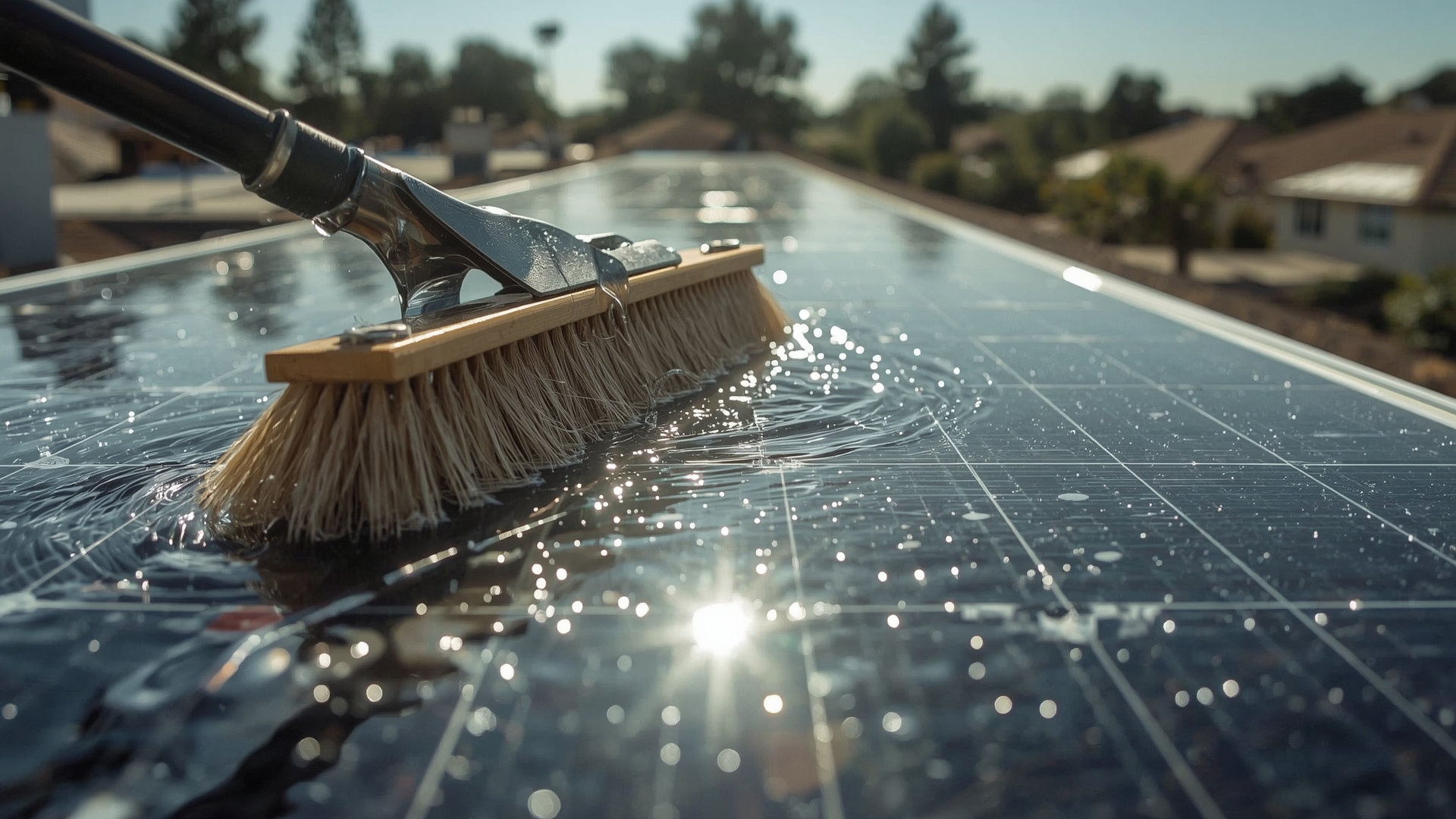
Quick Answer: Test your water TDS, set pump pressure to 40 to 60 PSI, start at the top row of panels, scrub with overlapping strokes, rinse from top down, and let the pure water air-dry without wiping. The whole process takes 20 to 45 minutes for a standard residential array.
Before You Start
- Check the weather: Clean on a cool, overcast day or in the early morning. Hot panels cause water to evaporate before it can rinse properly. Panel surface temperature above 95°F (35°C) significantly increases the risk of thermal stress on the glass.
- Test your water TDS: Dip your TDS meter in the output water. If it reads above 10 ppm, run more water through the filter or replace your DI resin before starting.
- Set your pump pressure: Connect your pump, set it to 40 to 50 PSI for residential panels, and run water through the hose to clear any air before attaching to the pole.
- Inspect the panels: Walk the array perimeter and look for cracked glass, damaged frames, or loose electrical connections. Do not clean damaged panels. Flag them for a solar technician first.
Cleaning Sequence
- Start at the top edge of the highest row. Work from left to right across each panel.
- Use overlapping strokes with the brush — about 50% overlap per pass. This ensures full coverage and prevents dry strips.
- Pay extra time on corner buildup and bird dropping spots. These require gentle scrubbing pressure, not high water pressure.
- After scrubbing each panel, do a final rinse pass from top to bottom to carry loosened soiling off the panel edge.
- Move to the next row down and repeat. Always work top to bottom so dirty water from upper panels doesn’t fall onto already-cleaned lower panels.
After Cleaning
Do not wipe the panels dry. This is one of the most common mistakes. Wiping with a cloth or squeegee can introduce micro-scratches over time and may deposit lint or fibers on the glass. Pure water air-dries spotlessly without any residue.
Check your inverter or monitoring app 24 to 48 hours after cleaning. A noticeable output improvement confirms the soiling was affecting performance. If output stays flat, the panels may need a more thorough inspection for shading issues or internal degradation.
Does Cleaning Solar Panels With a WFP Actually Improve Energy Output?

Quick Answer: Yes. Studies and field monitoring data consistently show 3 to 25% output improvement after cleaning, depending on soiling severity and local environment. Panels in arid or high-traffic areas see the largest gains. Clean panels can recover their cleaning cost in extra generation within one to two billing cycles.
The physics is simple. Solar panels generate electricity when photons from sunlight hit the photovoltaic cells beneath the glass. Dust, pollen, and bird droppings reduce the number of photons reaching the cells. Even a thin uniform layer of dust across the entire panel surface causes a measurable performance drop.
Bird droppings cause a disproportionate impact. Because they block a small area completely, they can cause a “hot spot” effect where shaded cells reverse-bias and drag down the output of the entire string connected to that panel. Regular WFP cleaning eliminates this risk before it builds.
Is Water Fed Pole Cleaning Safe for All Solar Panel Types?
Quick Answer: Yes, for the vast majority of panel types. Standard monocrystalline, polycrystalline, and bifacial glass panels are all WFP-compatible. Thin-film and frameless panels need lower pressure (30 to 45 PSI). Always check the manufacturer’s cleaning guidelines before starting.
Solar Panel Cleaning Compatibility by Type
| Panel Type | WFP Compatible | Max PSI | Special Considerations |
|---|---|---|---|
| Monocrystalline (framed) | Yes | 70 PSI | Standard procedure applies |
| Polycrystalline (framed) | Yes | 70 PSI | Standard procedure applies |
| Bifacial (glass-glass, frameless) | Yes, with care | 65 PSI | Avoid high pressure at exposed edges |
| Thin-film (CIGS, amorphous silicon) | Yes, with care | 55 PSI | Use the softest brush head available |
| PERC / TOPCon (advanced mono) | Yes | 70 PSI | Same protocol as standard mono |
What TDS Level Is Safe for Cleaning Solar Panels?
Quick Answer: Use water with a TDS of 0 to 10 ppm for solar panel cleaning. Water above 50 ppm will leave visible mineral spots. Water above 100 ppm can leave a persistent haze that reduces panel output almost as much as the soiling you removed.
A TDS meter is a small, inexpensive device (usually $10 to $30) that measures dissolved solids in parts per million. Dip the probe in your output water and read the number. Anything at or below 10 ppm is ready to use. Between 10 and 50 ppm is marginal — usable in a pinch but not ideal. Above 50 ppm, flush or replace your filter media before cleaning.
WFP System TDS Performance Comparison
| System Type | Output TDS (ppm) | Upfront Cost (USD) | Best Use Case | Maintenance Interval |
|---|---|---|---|---|
| DI-only (single stage) | 0 to 5 | $80 to $200 | Soft water areas (under 150 ppm input) | Resin replacement every 3 to 12 months |
| RO/DI (two stage) | 0 to 3 | $300 to $800 | Hard water areas (over 150 ppm input) | RO membrane every 2 to 3 years, DI resin every 6 to 18 months |
| Van-mount RO/DI (commercial) | 0 to 2 | $1,500 to $4,000 | Commercial contractors cleaning daily | RO membrane annually, DI resin monthly |
Can You Clean Solar Panels With a Water Fed Pole Without a Professional?
Quick Answer: Yes. Homeowners with ground-floor or low-pitch roof-mounted panels can safely use a residential WFP kit. You need a 30-foot pole, a soft brush head, a DI filter, a pump, and a TDS meter. The total equipment cost is $200 to $500 for a basic DIY setup.
DIY WFP cleaning makes sense for most residential arrays. The process is simple once you understand the pressure and water quality requirements. The main risk is not the cleaning itself — it’s using tap water without a filter, using too much pressure, or scrubbing with the wrong brush material.
DIY vs. Professional WFP Cleaning Cost Comparison
| Approach | Setup Cost | Cost Per Clean | Best For | Frequency Feasibility |
|---|---|---|---|---|
| DIY residential kit | $200 to $500 | $5 to $15 (consumables) | Single-family homeowners | Monthly if needed |
| Professional residential service | $0 upfront | $100 to $250 per visit | Homeowners who prefer outsourcing | 2 to 4 times per year |
| Professional commercial service | $0 upfront | $0.05 to $0.15 per watt | Commercial arrays and solar farms | Monthly or quarterly |
What Mistakes Should You Avoid When Using a Water Fed Pole on Solar Panels?
Quick Answer: The most common mistakes are using unfiltered tap water, exceeding 70 PSI, cleaning in direct midday sun, wiping panels dry after rinsing, and using stiff bristle brushes. Each of these can leave residue, damage seals, cause thermal shock, or scratch the glass surface.
Top 7 WFP Solar Panel Cleaning Mistakes
- Using tap water without filtration: Leaves mineral deposits that reduce output and are difficult to remove later.
- Cleaning in direct midday sun: Hot glass (above 95°F / 35°C) causes water to evaporate before rinsing fully. Residue and thermal stress are both risks.
- Using a pressure washer instead of a WFP pump: Pressure washers run 1,000 to 3,000 PSI — far above the safe 40 to 70 PSI range for panel frames and seals.
- Wiping panels dry with a cloth or squeegee: Introduces micro-scratches over time and deposits fiber residue. Pure water air-dries cleanly.
- Using stiff bristle brushes or abrasive pads: Scratches the anti-reflective coating many panels have on the glass surface. This coating is essential for maximizing light absorption.
- Ignoring damaged frames or cracked glass: Cleaning a panel with physical damage can force water into the cell layers, causing electrical failure or accelerated degradation.
- Starting from the bottom row: Dirty rinse water flows down and re-contaminates lower panels. Always start at the top and work down.
Frequently Asked Questions
Can water fed pole cleaning damage the anti-reflective coating on solar panels?
No, as long as you use a soft boar’s hair or soft nylon brush rated for glass surfaces. The anti-reflective coating is a thin silicon dioxide or magnesium fluoride layer applied to the panel glass. Gentle WFP scrubbing with pure water preserves it. Stiff brushes, abrasive pads, and harsh cleaning chemicals are what actually damage this coating over time.
Do I need to turn off my solar system before cleaning with a water fed pole?
You do not need to shut down the DC side of a grid-tied solar system to clean the panels. The panels are always energized when exposed to light. WFP cleaning is safe because you’re working from the ground and never touching live components. If you have any reason to access the roof or the inverter during the same service visit, consult a licensed electrician first.
How do I clean bird droppings off solar panels with a water fed pole?
Soak the dropping with pure water for 30 to 60 seconds before scrubbing. This softens the dried material and prevents it from acting as an abrasive when you brush over it. Never scrub a dry dropping. After soaking, two to three gentle strokes with your WFP brush are usually enough to remove it completely.
What is soiling rate and how does it affect cleaning frequency?
Soiling rate is the speed at which airborne particles settle on and reduce panel output. It is measured as the percentage of output loss per day or per month without cleaning. Desert regions can see soiling rates of 0.5 to 1% per day. Temperate suburban locations typically see 0.05 to 0.1% per day. Your soiling rate determines how frequently WFP cleaning is cost-effective for your specific installation.
Is deionized water or reverse osmosis water better for solar panel cleaning?
Both produce water pure enough for solar panel cleaning when they reach 10 ppm TDS or below. For homeowners in soft water areas, a DI-only filter is simpler and cheaper. In hard water areas (over 150 ppm tap TDS), an RO/DI system saves money in the long run by dramatically extending DI resin life. The water quality at the output is what matters, not the specific filtration method.
Can a water fed pole reach panels on a two-story house from the ground?
Yes. A 30-foot WFP pole provides enough reach for panels on most two-story residential rooftops with standard pitch angles. For steeper pitches or larger homes, a 35 to 40-foot pole is available. Always check the panel’s working angle — if the roof pitch is above 45 degrees, a longer pole keeps you at a safe, comfortable working position on the ground.