Most homeowners think about window cleaning the same way — grab a bottle of glass cleaner, wipe it down, and call it done. But what looks clean from the inside often isn’t, and what you can’t see can quietly cost you money. Professional window cleaning does more than make glass sparkle. It protects your windows, improves your home’s light quality, and catches problems before they become expensive repairs.
This guide breaks down exactly what you get when you hire a trained window cleaning technician — and why it’s different from what you can do on a Saturday afternoon.
Key Takeaways
- Streak-free results come from professional-grade tools and technique — not just better products.
- Professional cleaning extends window lifespan by removing corrosive contaminants that slowly degrade glass and seals.
- Technicians identify seal failures early — catching fogging, moisture, and failed insulated glass units before replacement costs spiral.
- Natural light increases measurably after professional cleaning, which affects energy use and indoor comfort.
- Safety is a serious factor — trained technicians use proper equipment for upper-story windows that pose real fall risks for untrained homeowners.
- DIY cleaning can damage glass through wrong products, hard water residue, and abrasive techniques.
What Does Professional Window Cleaning Actually Include?
Quick Answer: Professional window cleaning includes washing interior and exterior glass, cleaning frames and sills, removing hard water deposits, and inspecting seals and screens. Technicians use purified water systems, squeegees, and extension poles to clean every surface safely and thoroughly.
A professional service covers more than the glass pane itself. A trained technician cleans the frame, sill, and track — areas that collect mold, dirt, and debris that standard spray-and-wipe methods never touch.
Most professional services use one of two main systems: traditional squeegee method with professional-grade solution, or water-fed pole systems using purified (deionized) water. Purified water leaves no mineral residue because the dissolved solids have been removed — which is why it produces a spot-free finish as it dries.
What Does a Standard Professional Window Cleaning Service Cover?
- Exterior glass cleaning (ground floor and upper stories)
- Interior glass cleaning
- Frame and sill wipe-down
- Screen removal, cleaning, and reinstallation
- Hard water spot treatment (often as an add-on)
- Seal and gasket visual inspection
- Track vacuuming and debris removal
What Tools Do Professional Window Cleaners Use?
| Tool | Purpose | Why It Outperforms DIY |
|---|---|---|
| Professional squeegee (brass/stainless) | Streak-free glass wiping | Consistent rubber edge pressure vs. cloth smearing |
| Water-fed pole system | Upper-story exterior cleaning from ground | Eliminates ladder risk, reaches 40+ feet |
| Deionized/purified water | Spot-free rinse | Zero mineral content, no drying residue |
| Scrubber sleeve/applicator | Agitating and loosening surface dirt | More contact area than paper towels or cloths |
| Telescoping ladder system | Safe access to multi-story windows | Rated for professional use, stabilizer feet |
Why Can’t You Get the Same Results With DIY Window Cleaning?
Quick Answer: DIY cleaning typically leaves streaks from household cleaners, misses upper-story buildup, and risks scratching glass with paper towels or abrasive cloths. Without purified water or squeegee technique, mineral deposits and soap film build up over time and dull the glass.
The issue isn’t effort — it’s equipment and technique. Household glass cleaners like ammonia-based sprays can leave a film when used outdoors in sunlight. Paper towels and microfiber cloths redistribute dirt rather than remove it. And spray-bottle applications don’t generate enough wet coverage to let a squeegee glide cleanly.
Hard water is another silent problem. Tap water used for rinsing contains dissolved calcium and magnesium. When it dries on glass, it leaves white mineral deposits — called limescale or hard water spots. These etch into the glass over time and become nearly impossible to remove with standard cleaning.
What Cleaning Mistakes Can Damage Home Windows?
| Mistake | Damage Caused | How Common |
|---|---|---|
| Using ammonia-based cleaners on tinted glass | Degrades window tint film | Very common |
| Cleaning in direct sunlight | Rapid drying causes streaks and smears | Extremely common |
| Using abrasive scrubbing pads | Micro-scratches that trap future dirt | Common |
| Rinsing with hard tap water | Mineral deposits and etching over time | Nearly universal |
| Pressing too hard on double-pane glass | Stress on edge seals, accelerates seal failure | Less common but serious |
How Does Professional Window Cleaning Extend the Lifespan of Your Windows?
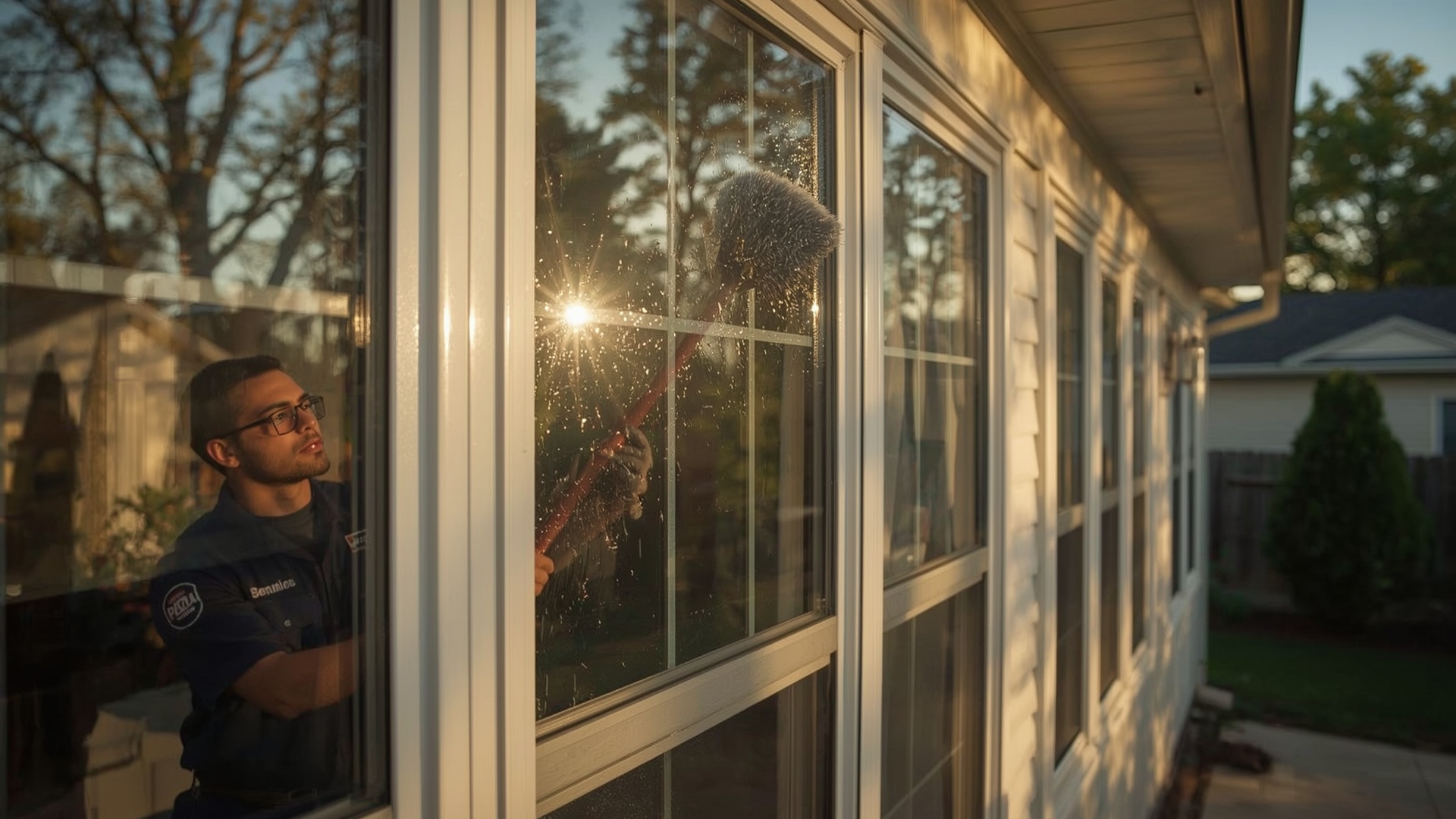
Quick Answer: Professional cleaning removes oxidation, hard water mineral deposits, and airborne contaminants that slowly corrode glass surfaces and degrade vinyl or aluminum frames. Regular cleaning every 3 to 6 months can extend window lifespan by years and delay costly full-unit replacement.
Windows are exposed to acid rain, pollen, mineral runoff, industrial pollution, and salt spray (in coastal areas). These don’t just make glass look dirty — they chemically bond to the surface. Silica deposits from concrete and mortar, for example, bond to glass at a molecular level and require professional-grade glass restorer solutions to remove safely.
Vinyl frames are also affected. UV exposure and oxidation cause vinyl to become brittle and discolored over time. Regular cleaning removes the buildup that accelerates this process. Clean frames also allow proper inspection — so cracks, gaps, or failing gaskets don’t go unnoticed until water damage has already started.
Window Lifespan and Maintenance Data by Window Type
| Window Type | Average Lifespan | Recommended Cleaning Frequency | Main Contaminants | Risk Without Regular Cleaning |
|---|---|---|---|---|
| Double-pane vinyl | 20–40 years | Every 3–6 months | Hard water, oxidation | Seal failure, frame brittleness |
| Aluminum frame single-pane | 15–20 years | Every 2–4 months | Oxidation, salt spray | Corrosion, staining |
| Wood frame windows | 30+ years (with maintenance) | Every 2–3 months | Moisture, mold, algae | Wood rot, paint failure |
| Fiberglass windows | 30–40 years | Every 4–6 months | Mineral deposits, UV haze | Surface pitting, seal degradation |
Can a Window Cleaner Identify Seal Failures Before They Become Expensive?

Quick Answer: Yes. Professional window cleaners routinely spot early signs of failed insulated glass unit seals — cloudiness, internal fogging, or moisture between panes. Catching seal failure early can save $200 to $600 per window versus waiting until full replacement is necessary.
Insulated glass units (IGUs) — the double or triple-pane glass found in most modern windows — rely on an airtight seal to maintain their insulating gas layer (usually argon or krypton). When that seal fails, outside air and moisture enter between the panes. You’ll see this as fogging, condensation, or a milky haze that can’t be cleaned from the surface.
A professional technician notices these signs during routine cleaning. Catching it early gives you options: IGU replacement (replacing just the glass unit, not the whole frame) typically costs $150 to $400 per window. Waiting until the problem compounds — or until water infiltrates the frame — can push that number to $800 or more, plus potential drywall and sill repair.
What Are the Early Signs of Window Seal Failure?
- Foggy or hazy appearance between glass panes that doesn’t wipe away
- Condensation or water droplets visible inside the pane
- Distorted or wavy appearance in the glass (gas has escaped, pressure changed)
- Noticeable increase in indoor drafts near the window
- Visible discoloration or mineral streaks on the inside surface of the inner pane
Window Seal Failure Costs at Different Stages
| Stage Detected | Visible Sign | Typical Repair Cost | Action Required |
|---|---|---|---|
| Early (fogging only) | Light haze between panes | $150–$300 (IGU replacement) | Replace glass unit only |
| Moderate (condensation inside) | Water droplets between panes | $300–$500 | IGU + possible frame inspection |
| Late (frame water damage) | Sill rot, drywall staining | $600–$1,200+ | Full window replacement + repair |
| Severe (structural damage) | Mold, framing damage | $1,500+ | Window replacement + remediation |
How Much Does Natural Light Improve After Professional Window Cleaning?

Quick Answer: Dirty windows can block 20% to 30% of natural light compared to clean glass. Professional cleaning restores full light transmission, which can reduce daytime artificial lighting needs, improve mood, and make rooms feel noticeably larger and warmer without changing anything else.
Glass doesn’t have to look visibly dirty to block light. A thin film of oxidation, mineral deposits, or airborne grease (from cooking or traffic exhaust) reduces light transmission gradually. You won’t notice the change day to day — but the difference before and after a professional clean is often striking.
More natural light has real downstream effects. Rooms that feel dark get used less. Artificial lighting compensates, which increases electricity costs. In colder months, solar heat gain through clean glass also contributes to passive warming — a minor but measurable effect on energy bills over a full season.
How Does Window Cleanliness Affect Energy Efficiency?
Clean windows allow full solar heat gain during winter months. Dirty or filmed glass partially blocks infrared light, reducing passive heating. This is most relevant for south-facing windows in homes without heavy shading.
In summer, the effect is reversed — clean windows transmit more heat. This is why window film and shading strategies matter in hot climates. The point is that window cleanliness directly affects your home’s thermal envelope in ways most homeowners don’t consider.
Is It Safer to Hire a Professional for Multi-Story Window Cleaning?
Quick Answer: Yes. Falls from ladders are among the most common causes of serious home injury. Upper-story window cleaning requires working at 10 to 25 feet or higher. Professionals use water-fed pole systems, stabilized ladders, and proper harness setups that untrained homeowners lack the equipment and training to replicate safely.
According to the U.S. Consumer Product Safety Commission, ladders account for over 164,000 emergency room visits annually. Most DIY falls happen during routine maintenance tasks — cleaning, painting, and gutter work — not extreme situations. Upper-story window cleaning puts untrained people at serious risk because it requires extended arm reach, frequent ladder repositioning, and working on wet, slippery surfaces.
Professional window cleaners are trained in ladder safety protocols, weight distribution, and using extension systems that keep them closer to the ground. Water-fed pole systems, for example, allow technicians to clean windows up to four stories high from ground level — no ladder required at all.
Height and Risk Comparison: DIY vs. Professional Window Cleaning
| Window Location | Typical Height | DIY Risk Level | Professional Approach |
|---|---|---|---|
| Ground floor exterior | 0–4 feet | Low | Standard squeegee + solution |
| Second story exterior | 12–18 feet | High | Water-fed pole or stabilized ladder |
| Third story exterior | 22–30 feet | Very high | Water-fed pole (no ladder) |
| Skylights / roof windows | Varies | Extreme | Rope access or specialist equipment |
| Atrium / cathedral windows | 20–40 feet interior | Extreme | Internal extension poles or scaffolding |
What Is the Cost of Professional Window Cleaning for a Home?
Quick Answer: Professional window cleaning for a standard home typically costs $150 to $400 for a full-service visit, depending on the number of windows, stories, and condition. Homes with hard water buildup or construction residue may pay more for initial restoration cleans before ongoing maintenance pricing applies.
Pricing varies by region and service scope, but most companies charge per window pane, per hour, or as a flat rate for the full property. A single-story home with 15 to 20 windows generally falls in the $150 to $250 range. A two-story home with 25 to 35 windows typically runs $250 to $400.
Initial cleans often cost more than maintenance visits. If your windows haven’t been professionally cleaned in several years, a first visit may include hard water spot removal, oxidation treatment, or screen restoration — each of which adds time and cost. Ongoing quarterly or bi-annual service is typically priced lower per visit because less restoration work is needed.
What Factors Affect Professional Window Cleaning Pricing?
- Number of panes: Most quotes are based on total pane count, not just window units
- Number of stories: Upper-story access adds time and equipment requirements
- Window condition: Hard water staining, paint overspray, or construction residue requires extra treatment
- Interior vs. exterior: Interior-only or exterior-only service costs less than full in-and-out cleaning
- Screen service: Removing, washing, and reinstalling screens is usually an add-on
- Geographic market: Urban and high cost-of-living areas have higher labor rates
How Often Should Homeowners Schedule Professional Window Cleaning?
Quick Answer: Most homes benefit from professional window cleaning two to four times per year. Homes near the ocean, major roads, or in high-pollen areas may need quarterly service. Homes in lower-traffic suburban areas can often maintain quality results with twice-yearly cleaning.
The right frequency depends on your environment. Coastal homes deal with salt spray that etches glass quickly. Homes near busy roads accumulate exhaust film and grit. Properties surrounded by trees face pollen, sap, and bird activity. Each of these conditions accelerates surface contamination at a faster rate than a quiet inland suburban home.
Think of it the same way as getting a car’s oil changed — the interval depends on how hard you’re running it, not just the calendar. A window facing a dusty, west-facing driveway needs more attention than a sheltered north-facing bedroom window.
Recommended Cleaning Frequency by Home Environment
- Coastal (within 1 mile of ocean): Every 6 to 8 weeks
- Urban or near high-traffic roads: Every 2 to 3 months
- Suburban with trees and pollen: 3 to 4 times per year
- Rural or low-traffic suburban: 2 times per year
- Post-construction or renovation: Specialist restoration clean required before regular schedule
What Should You Look for When Hiring a Professional Window Cleaner?
Quick Answer: Look for a company with liability insurance of at least $1 million, verifiable customer reviews, clear service inclusions in writing, and trained (not just hired-day-of) technicians. Avoid companies that can’t confirm insurance coverage or provide itemized quotes before starting work.
Insurance is non-negotiable. A technician working at height on your property creates liability exposure. If they’re injured on your property and the company carries no insurance, you could face a claim. Reputable companies carry general liability insurance and workers’ compensation as standard.
Beyond insurance, ask about their water system. A company using tap water and standard squeegees will produce different results than one using a purified water-fed pole system. Neither is automatically wrong — but you should know what you’re paying for and what results to expect.
Questions to Ask Before Hiring a Window Cleaning Company
- Do you carry general liability and workers’ compensation insurance?
- What water system do you use — purified water-fed pole or traditional squeegee?
- Does the quote include interior, exterior, frames, and screens?
- How do you handle hard water staining or construction residue?
- Are your technicians trained employees or day-labor subcontractors?
- What is your policy if a window is damaged during cleaning?
Frequently Asked Questions
Does professional window cleaning prevent hard water stains?
Regular professional cleaning removes mineral deposits before they bond permanently to glass. Purified water systems — which use deionized water with zero dissolved solids — prevent new hard water spots from forming after each visit. Without this, tap water rinsing redeposits minerals every time.
Will professional window cleaning remove paint overspray or construction residue?
Yes, but it requires a specialized restoration clean rather than standard maintenance service. Technicians use tools like razor scrapers and glass-safe chemical strippers to remove paint, silicone, and mortar. This is typically priced separately from routine cleaning and should be scheduled after construction work is complete.
Can window cleaning help with mold or algae on frames?
Professional cleaning removes surface mold and algae from frames and sills as part of a standard service. Persistent or deeply embedded mold may require a separate treatment product. If mold is present inside the wall cavity or behind the frame, that’s a structural issue beyond the scope of window cleaning.
Is professional window cleaning worth it for newer homes?
New homes often have construction residue, paint overspray, and silicone splatter on glass from installation. Professional cleaning removes these before they etch into the surface. Establishing a maintenance schedule early also prevents the harder and more expensive restoration work that builds up over several years of neglect.
How do I maintain clean windows between professional visits?
Use a rubber squeegee and a small amount of professional-grade window cleaning solution for spot cleans between visits. Avoid paper towels, which leave lint, and ammonia-based sprays on tinted glass. Removing bird droppings and sap quickly — within a day or two — prevents them from bonding and etching the glass surface.
Do professional window cleaners clean the inside of the window frame track?
Most full-service providers include track vacuuming and wiping as part of a complete clean. Tracks collect dirt, insect debris, and moisture that can accelerate frame corrosion and seal degradation. Always confirm this is included in your quote, as some exterior-only services skip interior frames entirely.